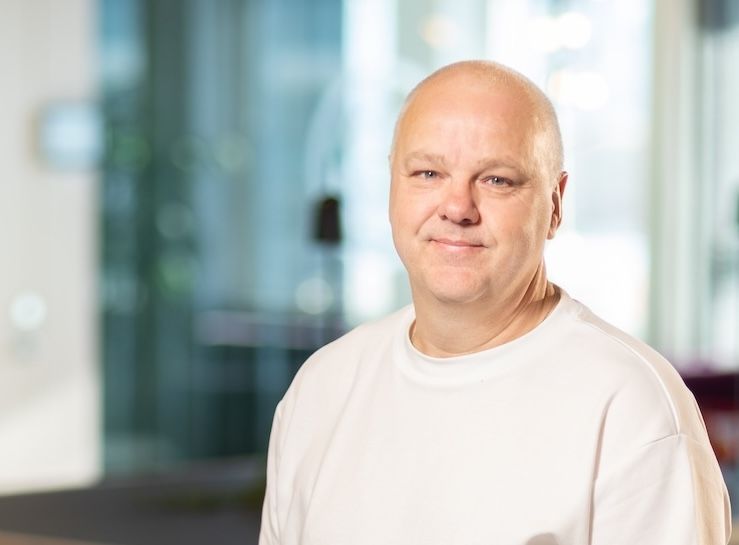
How did you end up in Sweden? I’m originally from a very small fishing village in Iceland. Moving to Sweden wasn’t something we carefully planned - it happened when my son got the opportunity to train with IFK Göteborg. We moved in 2019, and on my very first day here I had an interview with Vinnter. Things aligned quickly, my son later signed a contract, and Sweden became home.
Did you work with IoT before joining Vinnter? Not directly. I graduated as a software engineer in the mid-90s, originally planning to become a musician. I’ve worked with everything from government financial systems to air traffic control, and my career gradually expanded across industries and roles.
What made you join Vinnter? At that point, I had been up and down the ladder. I’ve been a CEO, a director, a manager, and a developer. Leadership roles were never a goal in themselves, they just happened.
What I really wanted when I joined Vinnter was to get closer to the floor again. I wanted to build, learn IoT, and work hands-on with development. I did that for about a month and a half before I was assigned to Polestar.
What did you learn at Polestar? That product ownership is where I’m strongest. Working in the space between technology, business, and people. I’m quick at understanding systems and contexts, which allows me to move fast and make good decisions together with specialists.
Any example you’re particularly proud of? Early on, we created a modular framework at Polestar that’s still being used today, even in new markets. At the time, we didn’t know it would scale that way. That’s one of the trickiest parts of architectural decision-making. You’re not just designing for today’s requirements, you’re designing for future needs that you don’t even know yet.
How do you see IoT developing in the coming years? Two things stand out. First, IoT solutions will become much easier to build thanks to AI. AI will be a bigger and more integrated part of IoT going forward.
Second, we’ll see more on-device or location-based AI, where intelligence lives inside the equipment itself. That allows for more independent, resilient, and remote solutions. Security will be a huge part of this as well.
You originally planned to become a musician. Why didn’t you pursue that full-time? I realised early on that making it in the music industry is statistically very unlikely. There’s a high chance you won’t succeed, and I wanted a backup. So I chose to study for a couple of years, planning to return to music later, but I got stuck in tech - but in a good way.
Music never disappeared. I still play, and today I have a session band with very experienced musicians from Sweden, Iceland, Germany and Ireland. We play at a professional level, but without depending on music for income. That gives us freedom. We support artists we believe in and play because we love it.